29 matched listings
Cordless Robotic Pool Cleaners
Cable-free cleaners for owners who can manage charging and wet retrieval.
Browse collectionA robotic pool cleaner should match the pool—not the loudest feature list. Compare pool type, length, finish, debris, cleaning zones, power method and retrieval before choosing a model.

Choose the physical constraint that matters most. The result sends you to a focused collection; it does not pretend one robot is universally perfect.
These collections organize exact Amazon listings by power, pool type and cleaning coverage. Product pages preserve model-level differences instead of collapsing a family into one description.
Cable-free cleaners for owners who can manage charging and wet retrieval.
Browse collectionContinuous-power robots for scheduled cleaning without a battery wait.
Browse collectionModels whose exact listings support in-ground pool use.
Browse collectionFloor-focused and compatible robots for above-ground pools.
Browse collectionPool robots that add wall coverage beyond floor vacuuming.
Browse collectionMulti-zone cleaners whose current listings include waterline work.
Browse collectionConnected robots for scheduling, setup or mode selection.
Browse collectionHigher-coverage options where reach, cycle design and retrieval matter.
Browse collectionRight-sized choices for compact and simpler pool layouts.
Browse collectionAs an Amazon Associate, we may earn from qualifying purchases.
Best for: Owners who want a compact established corded cleaner
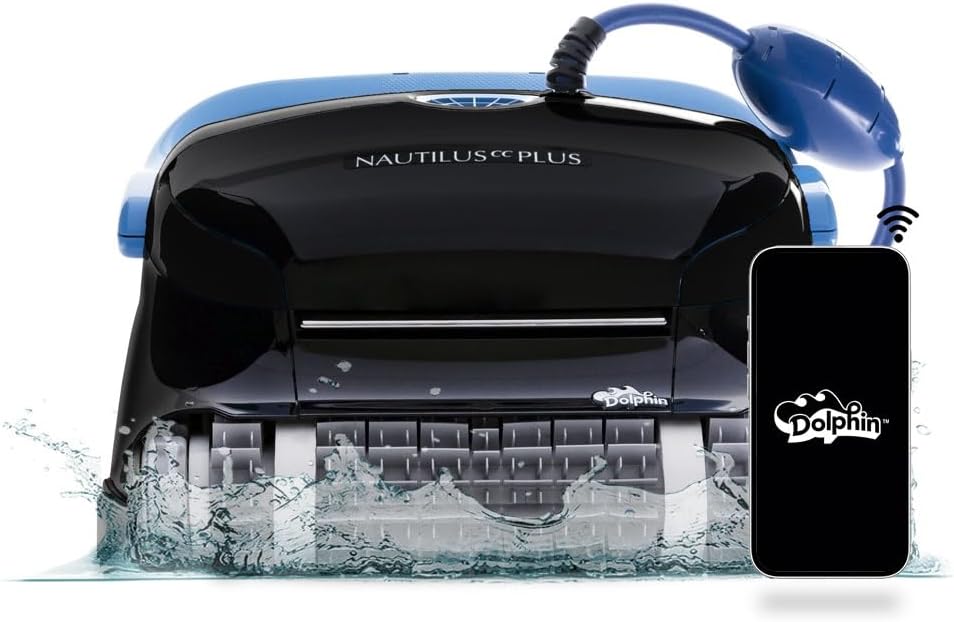
Best for: Buyers comparing a widely searched midrange Dolphin

Best for: Large pools needing broader cleaning-zone coverage

Best for: Owners wanting waterline coverage without jumping blindly to the largest model

Best for: Smaller pools where low lifting weight and straightforward operation matter

Best for: Owners prioritizing deep cleaning and full-zone coverage
“In-ground” and “above-ground” are not interchangeable marketing details. Pool length, floor slope, transition radius, minimum water depth, finish and obstacles can determine whether a robot moves predictably. Read the exact manual rather than borrowing compatibility from another product in the same brand family.
A machine that vacuums the floor may not climb walls. A wall climber may not scrub the waterline. Steps, benches, tanning ledges and the water surface create different navigation problems. Buy only the zones the listing and manual explicitly support.
Cordless cleaners remove floating-cable management, but introduce charging time, battery aging and a retrieval routine. Corded robots avoid battery downtime, yet need GFCI-protected power, a dry power-supply position and enough properly managed cable.
Large leaves need basket volume and openings that do not choke immediately. Sand, silt and pollen need finer filtration and may require more frequent rinsing. A single suction or flow number rarely predicts both jobs because brands test and describe performance differently.
| Type | How it moves | Where debris goes | Main tradeoff |
|---|---|---|---|
| Electric robotic | Onboard motors and programmed movement | Onboard basket or cartridges | Separate machine to lift, clean and store |
| Suction-side | Pool-pump suction through hoses | Pool filtration path or leaf canister | Depends on pump flow and hose setup |
| Pressure-side | Return-side water pressure, sometimes with booster pump | Onboard bag | Plumbing and booster requirements |
| Robotic skimmer | Solar or battery surface propulsion | Surface basket | Does not clean the pool floor |
Read the full robotic-versus-suction comparison or use the running-cost calculator.
Drive motors move tracks or wheels while sensors, timers or mapping logic vary the path.
Brushes loosen material from surfaces the exact model is designed to reach.
An onboard pump draws loosened debris into a basket, bag or cartridge that the owner cleans.
They can be worth it when automatic debris pickup and brushing replace enough hands-on vacuuming to justify the purchase, handling and maintenance. They are less compelling when the pool is tiny, the shape defeats the robot, or the owner expects one device to sanitize water, skim the surface, scrub every step and eliminate all manual care.
A correctly matched robot can collect settled debris independently of the circulation system, run on a repeatable cycle and keep its load out of the main pool filter. That can reduce the most repetitive part of maintenance.
Robots do not balance water chemistry, disinfect the pool, empty themselves universally, repair circulation problems or guarantee access to every shelf and corner. The realistic goal is less manual vacuuming—not a maintenance-free pool.
It is an independent electric or battery-powered machine that moves through a pool, brushes surfaces and collects debris in an onboard filter. It does not replace sanitation or balanced water chemistry.
Neither is automatically better. Cordless models remove cable management but add charging, battery aging and wet retrieval. Corded models can provide continuous power but require safe power-supply placement and cable care.
Only models designed for those zones. Floor cleaning, wall climbing, waterline scrubbing, step coverage and surface skimming are separate capabilities.
Independent robotic cleaners do not rely on the circulation pump for movement or onboard debris collection. Suction- and pressure-side automatic cleaners do, which is why we label them separately.
The useful schedule depends on swimmer load, weather, surrounding trees, filtration and how much debris enters the pool. Start with the manual's cycle guidance and adjust after inspecting the basket and missed areas.